Local Pack SEO 2026: Debunking 13 Local SEO Myths and What Works Instead

Local Pack SEO 2025 is more competitive than ever. Google Maps results are crowded, and many businesses still follow outdated tactics that waste time or quietly damage visibility. This guide debunks 13 common local SEO myths and explains what actually improves rankings in the Local Pack today.
Local SEO is full of recycled advice. Some of it was true years ago, but in 2025 it’s either incomplete or flat-out wrong. The Local Pack is shaped by relevance, distance, and prominence. If you optimize only one layer—like your Google Business Profile—and ignore citations, localized content, and reviews, you’ll hit a ceiling fast.
Below are the myths that most often block growth, plus the exact practices that work now.
Myth 1: “GBP verification alone guarantees Local Pack rankings”
Reality: Verification is required, but it only lets you compete. Rankings depend on ongoing signals: complete data, activity, and trust across the web.
What works in 2025:
- Verify your profile.
- Fill every core field.
- Keep it updated weekly.
- Align GBP with your website and citations.
Myth 2: “NAP consistency doesn’t matter anymore”
Reality: NAP still matters because it confirms that all mentions refer to the same real business. Even minor mismatches can fragment authority.
What works in 2025:
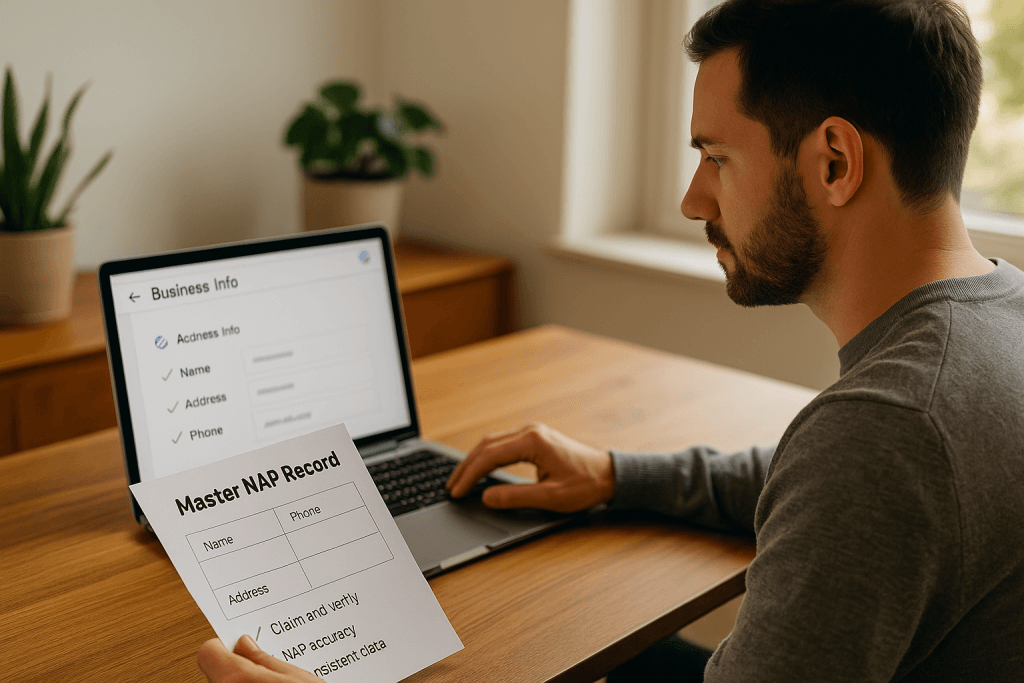
- Create a single master NAP record.
- Copy it identically across Google, your website, Apple Maps, Bing Places, Yelp, Facebook, and niche directories.
- Standardize formatting (suite numbers, abbreviations, phone style).
Myth 3: “Any category is fine if it’s close enough”
Reality: Categories are a core relevance driver. A “near match” category can stop you ranking for your best terms.
What works in 2025:
- Choose a primary category that matches your trade exactly (e.g., “Electrician,” not “Contractor”).
- Add only 2–3 tightly related secondary categories.
Myth 4: “Photos don’t affect Local Pack visibility”
Reality: Photos influence engagement and trust, which feed prominence. Active photo uploads correlate with stronger Local Pack performance in competitive areas.
What works in 2025:
- Upload 10–15 fresh, high-quality photos per month.
- Show real work, staff, signage, vans, and before/after results.
- Use natural local captions.
Myth 5: “Google Posts are optional”
Reality: Posts are both a freshness signal and a conversion surface. Consistent posting expands your Local Pack footprint.
What works in 2025:
- Publish 4–6 posts monthly.
- Focus each post on one message.
- Add strong CTAs: “Call now,” “Book,” “Get directions.”
Myth 6: “Reviews only matter for trust”
Reality: Review volume, velocity, rating average, and owner responses all influence prominence.
What works in 2025:
- Ask for reviews consistently.
- Reply quickly (aim for <24 hours).
- Reflect service + location in replies naturally.
Myth 7: “Q&A is user-generated noise”
Reality: Q&A helps Google interpret your services and reduces friction for customers. It’s a visibility surface many competitors ignore.
What works in 2025:
- Seed practical questions based on real customer intent.
- Answer in 2–4 clear lines.
- Include service and area wording naturally.
Myth 8: “All directory sites help equally”
Reality: Low-quality citations add little and increase the risk of NAP errors.
What works in 2025:
- Prioritize directories with strong local or niche relevance.
- Audit your top 10–15 first.
- Scale beyond that only if you can maintain accuracy.
Myth 9: “Service areas don’t matter if you don’t have a storefront”
Reality: Service areas are critical for trades and mobile services. They expand proximity relevance and help you show up for nearby queries.
What works in 2025:
- Define real service areas in GBP.
- Mirror them on geo landing pages.
- Avoid inflated or fake zones.
Myth 10: “Local SEO works the same in every city”
Reality: The framework is universal, but competition and intent patterns vary by neighborhood.
What works in 2025:
- Research Local Pack leaders by city/area.
- Identify gaps in services, posts, and reviews.
- Localize by district and persona, not just by city name.
Myth 11: “You can’t target niche personas in GBP”
Reality: You can, if those niches reflect real demand (“women-owned,” “emergency,” “licensed”). But stuffing modifiers into the business name is risky unless legally true.
What works in 2025:
- Use persona cues in posts, services, descriptions, and Q&A.
- Keep naming strictly honest and consistent.
Myth 12: “Only GBP matters for Local Pack SEO 2025”
Reality: GBP is central, but your website provides the strongest relevance proof. Packs still read on-page context.
What works in 2025:
- Build location-specific landing pages.
- Add LocalBusiness structured data.
- Link geo pages tightly to service pages.
For reference, follow Google’s official profile guidance and schema standards.
Helpful resources:
- Google Business Profile help center
- Schema.org LocalBusiness markup documentation
Myth 13: “Once you optimize, you’re done”
Reality: Local SEO decays without maintenance. Competitors change, features evolve, and your data gets stale.
What works in 2025:
- Audit quarterly.
- Track changes in a log.
- Assign a profile owner.
- Run 90-day experiments (booking, service catalogs, new post formats).
Local Pack SEO 2025 Strategy (Action Plan)
A winning Local Pack SEO 2025 system is simple but relentless.
1. Lock in your Google Business Profile
- Verify ownership.
- Ensure accurate NAP.
- Choose a prime primary category.
- Add real attributes and service areas.
- Grant access only to trusted team members.
2. Match intent with responsiveness
- Reply to every review quickly.
- Use real customer wording in responses.
- Keep Q&A aligned with the next steps users usually take.
3. Publish localized content monthly
- 4–6 short updates per month.
- 10–15 new photos monthly plus 1–2 short videos.
- Add local cues and service terms naturally.
4. Maintain clean citations
- Audit your presence across 10–15 relevant directories.
- Fix mismatches immediately.
- Expand only if consistency is guaranteed via a master record.
5. Research competitors for gaps
Review the top 5 Local Pack leaders in your area:
- service breadth
- posting cadence
- review themes
Then differentiate with clear value cues—pricing, hours, unique services.
6. Track results weekly
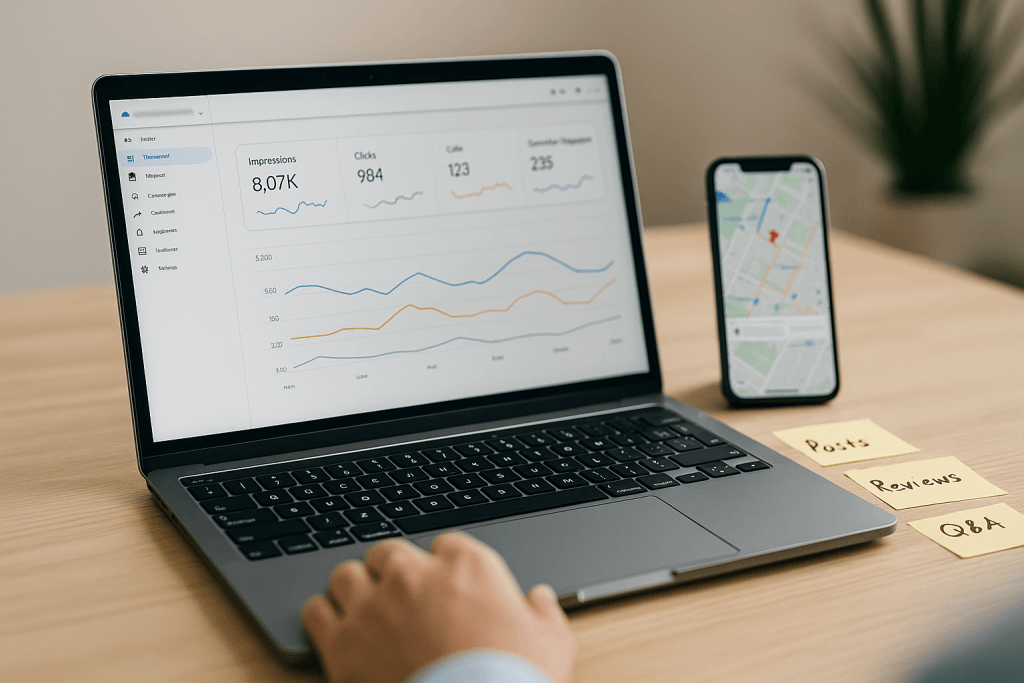
Monitor:
- map impressions
- profile clicks
- call clicks
- direction requests
Keep what lifts performance, kill what doesn’t.
Geo Keywords for Local Pack SEO 2025
High-intent geo keyword targeting shows Google where your demand is strongest.
Templates to build your list
- [City] [service] (“Seattle plumber”)
- [Neighborhood] [service] in [City]
- [service] in [City] prices
- [City] [service] near me
- Downtown [City] [service]
- Women-owned [service] in [City]
Prioritization rules
- Give higher weight to explicit local intent (“in [City],” “near me,” “downtown,” “prices”).
- Check who ranks for each term.
- Prioritize gaps where intent is high but competition is weak.
Implementation
- Publish 2–3 dedicated pages per major service area.
- Cluster neighborhoods under one city hub.
- Tight internal linking: geo pages → service pages → geo pages.
Final takeaway
Local SEO in 2025 isn’t about hacks. It’s about credible signals repeated everywhere: accurate business data, active profiles, localized content, and real customer engagement.
Treat Local Pack SEO 2025 like an operating system, not a one-time setup. Maintain it, measure it, and improve it quarter by quarter—and you stay in the pack.
📚 More on SEO & Digital Marketing
- What is Local Search Marketing? A Beginner's Guide to Local SEO
- AI Local SEO Automation: The 2026 Expert Guide to Boost Local Rankings
- Local SEO for Multiple Locations - 9 Must-Take Steps to Success
- 10 Best Local Rank Tracker Tools for 2026 | Local SEO
- Local SEO - The Ultimate Guide to Ranking in 2026
Ready to leverage AI for your business?
Book a free strategy call — no strings attached.


